Automation and Integration
Collaborative Robots
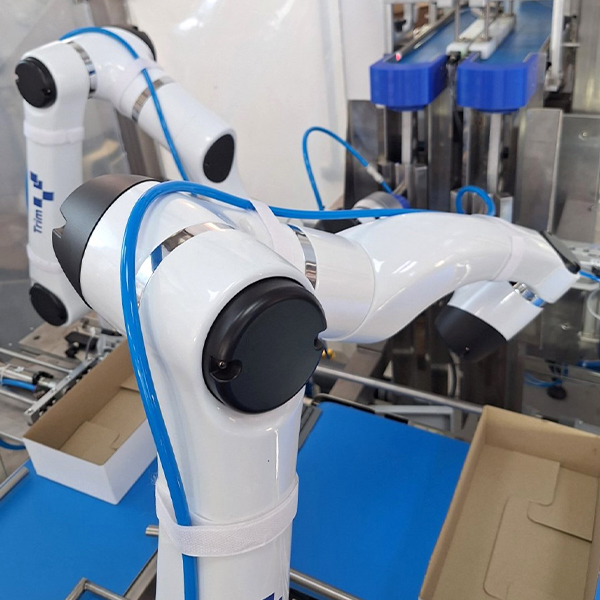
Collaborative robots, or cobots, are robotic solutions designed for safe and efficient operation in direct collaboration with people. They are intended for production and logistics processes where automation of repetitive operations is required, while maintaining flexibility and enabling fast production changeovers.
Unlike conventional industrial robots, cobots can be implemented faster, programmed more easily, and do not require complex safety fencing, making them an ideal solution for modern production facilities.
When Are Collaborative Robots the Right Solution?
Cobots are the optimal choice in situations where:
- there is a need to automate repetitive or manual tasks
- production requires frequent changes of products, formats, or batches
- there is limited space or no justification for conventional robotic cells
- errors need to be reduced and productivity increased
- faster return on investment in automation is required


This is why collaborative robots are often introduced as the first step towards automation, or as a flexible extension of existing lines.
Collaborative robots are successfully used across various industries and production processes, including product packing and repacking, palletising and depalletising of small and medium loads, pick & place operations, assembly and auxiliary assembly tasks, handling of parts and semi-finished products, as well as testing, measurement, and quality control. They are particularly effective in processes that require high repeatability, consistent quality, and reliable operation across multiple shifts.
The most common applications include:
- Cobots for Packaging Automation – precision, speed, and efficient use of space
- Cobots for Palletising – faster stacking, reduced risk of injury, and warehouse optimisation