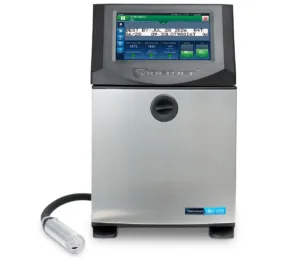
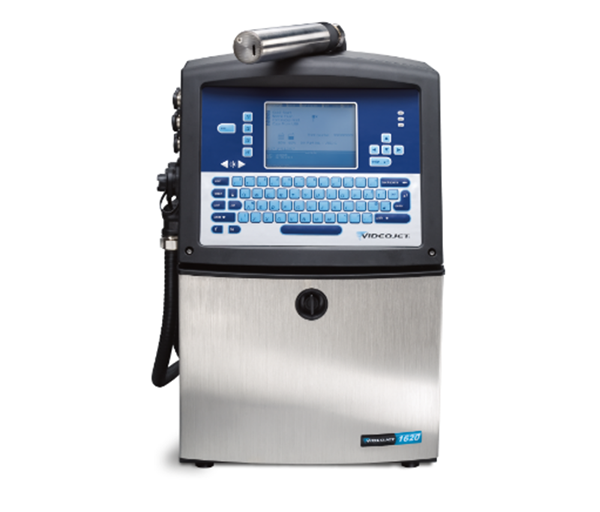
Industrial Small Character Inkjet Printers
Continuous inkjet (CIJ) printers are industrial devices for automatic marking and coding of products and packaging during the production process, using a non-contact inkjet principle. They enable precise printing of variable data, such as dates, expiry dates, lot numbers, import and export declarations, serial numbers, and codes, directly onto products without stopping the production line.
These devices print variable data on products from a distance of 1–2 cm, creating non-contact dot-matrix prints with small characters from 0.6 to 12 mm in height. They generally print up to 5 lines of text, while certain printer models can print up to 8 lines.
Industrial inkjet printers (also known as continuous inkjet printers, CIJ printers, product markers, automatic date coders, or inkjet coders), generate fine ink droplets that are applied to different product surfaces. This technology enables reliable printing on flat and curved surfaces, plastics, glass, metal, film, and other materials, at high speeds suitable for modern production lines.

In industrial applications, CIJ printers provide real-time variable data printing, stable operation with minimal maintenance, and integration with conveyor and packaging systems. Different inks can be used depending on the material and operating conditions, including solutions for food packaging. In production environments where direct marking on products or on the inside of packaging is required, inks approved for direct food contact or for printing directly onto food products can be used,
such as for date coding and marking eggs. Industrial inkjet printers can be used for marking bottles, closures, and caps. They are suitable for printing on all types of packaging, self-adhesive and paper labels, cups, cans, tins, sachets, and small packs. Thanks to the availability of different printer models, marking is also possible on cables, pipes, hoses, and similar products. Inkjet printers are widely used in the dairy and beverage industries, as well as in the meat, construction, and pharmaceutical industries.
Black inks are the most commonly used and are suitable for printing the majority of messages. Videojet printers can also use white, yellow, blue, red, and other ink colours. A special category includes thermochromic inks, which change colour after the product pasteurisation or cooking process. All inks supplied by TRIM with inkjet printers for use in the food industry have the relevant European certificates.